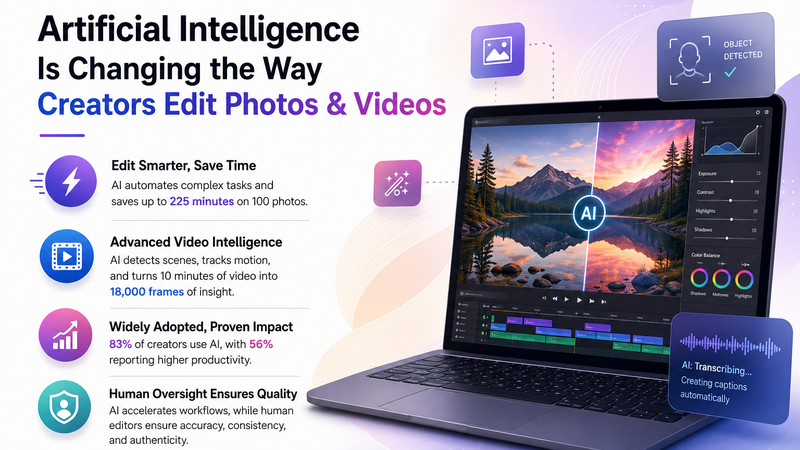
Video editing has moved far beyond trimming clips and adding transitions. Today, creators are expected to produce polished videos quickly while adapting content for social platforms, marketing campaigns, tutorials, and short-form media. This shift has made efficient editing more important than ever.
Artificial intelligence is becoming a practical part of that process. Instead of replacing creative judgment, AI-powered tools can reduce repetitive work, accelerate production, and help creators experiment with different ideas. The result is a workflow that combines human storytelling with increasingly capable technology.
For professionals, the biggest opportunity is not simply editing faster. It is building a more flexible process that leaves more time for planning, storytelling, visual direction, and audience engagement.
Why AI Matters in Modern Video Production
Traditional editing can require considerable time, particularly when a project involves multiple clips, formats, captions, audio adjustments, and visual effects. Repetitive tasks can consume hours before the creative work is even finished.
AI-assisted editing can help address this problem by supporting common production tasks and making certain workflows more efficient. Creators can spend less time navigating routine processes and more time deciding what the audience should see and hear.
This is particularly useful for marketers and businesses producing content regularly. A single campaign may require a long-form video, several social clips, promotional variations, and mobile-friendly versions. An efficient editing workflow makes it easier to adapt the same creative idea without rebuilding everything from scratch.
The goal is not automation for its own sake. The most useful AI tools are those that support creative decisions while allowing the editor to remain in control.
Combining AI Assistance With Human Creativity
One of the most important developments in video editing is the growing balance between automation and human input. AI can assist with technical or repetitive elements, but storytelling still depends heavily on context, emotion, pacing, and audience understanding.
For example, a creator may use AI-assisted features to speed up an initial editing process and then refine the result manually. This approach preserves creative control while reducing the amount of time spent on routine adjustments.
Tools such as the CapCut × Codex video editor reflect the broader movement toward integrating advanced AI capabilities into accessible video-creation workflows. Rather than treating AI as a separate stage of production, modern platforms increasingly place intelligent assistance directly inside the creative process.
This combination can be especially valuable for creators who need to produce content consistently. AI can help with efficiency, while the creator remains responsible for the message, style, and final editorial decisions.
The Growing Importance of Short-Form Content
Short-form video continues to influence how businesses, creators, and publishers communicate online. Platforms built around brief, highly engaging videos have changed audience expectations, making strong openings, clear storytelling, and efficient pacing essential.
Producing effective short-form content is not necessarily easier than producing longer videos. In many cases, it requires more careful editing because every second needs to contribute to the overall message.
AI-assisted workflows can help creators manage this growing demand. Features that streamline editing, organization, captions, formatting, or other repetitive processes can make it easier to adapt content for different channels.
The ability to create multiple versions from a central concept is also becoming increasingly important. A creator might develop one core video and then produce shorter variations for different audiences. An efficient workflow helps maintain consistency while allowing each version to suit its platform.
Making Video Workflows More Efficient
Efficiency is one of the strongest reasons professionals are exploring AI-powered editing. A well-designed workflow can reduce unnecessary steps from the beginning of a project through final delivery.
Creators can start by organizing footage and defining the purpose of each video before editing begins. Once the structure is clear, AI-assisted features can help accelerate selected parts of production. Human review remains essential for checking accuracy, pacing, tone, and visual quality.
This approach is especially useful for teams with frequent publishing schedules. Instead of treating every video as an entirely separate project, teams can establish repeatable processes that make production more predictable.
Efficiency also creates room for experimentation. When routine tasks take less time, creators can test alternative openings, different pacing choices, or multiple visual approaches without dramatically increasing production demands.
What the Future Holds for AI Video Editing
AI video technology is likely to become increasingly integrated into everyday creative workflows. As these systems improve, creators may gain more sophisticated ways to transform ideas into visual content while maintaining greater control over the final result.
However, technology alone will not determine whether a video succeeds. Strong concepts, accurate information, good storytelling, and an understanding of the intended audience will remain fundamental.
The most successful creators are therefore likely to view AI as a creative partner rather than a complete replacement for editorial judgment. The technology can handle or accelerate selected parts of production, while people provide the direction and purpose.
For businesses and independent creators alike, learning how to combine these strengths can provide a long-term advantage. Video production is becoming more accessible, but quality still depends on thoughtful decisions.
Conclusion
AI is changing video editing by making complex workflows more accessible and reducing the time required for repetitive production tasks. From adapting content for different platforms to supporting faster editing processes, intelligent technology can help creators meet the growing demand for visual communication.
The real value comes from combining automation with human expertise. Creators still need to understand their audience, develop compelling ideas, and make careful editorial choices. AI simply gives them more efficient ways to bring those ideas to life.
As video continues to dominate digital communication, flexible editing workflows will become increasingly important. Professionals who learn to use AI thoughtfully can spend less time on routine production and more time on creativity, experimentation, and meaningful storytelling. The future of video editing is not purely automated—it is a collaboration between increasingly capable technology and human creative judgment.